


Irma Grese (October 7, 1923 – December 13, 1945) was a German SS guard who served at Nazi concentration camps, including Ravensbrück, Auschwitz-Birkenau, and Bergen-Belsen. Known for her extreme cruelty and sadism, she was one of the most infamous female perpetrators of the Holocaust. Her actions during the war led to her conviction for war crimes, and she became one of the youngest women executed under British military law at the age of 22.
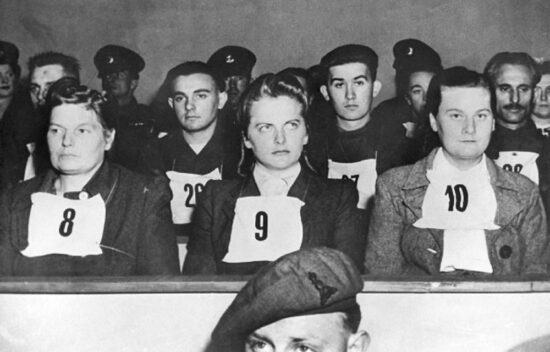
Irma Ida Ilse Grese was born on October 7, 1923, in Wrechen, Germany, to a farming family. Her early life was marked by instability. Her mother, Berta, committed suicide in 1936 after discovering her husband’s infidelity, leaving Irma and her siblings to be raised by their strict father, Alfred.
Irma left school at 15, reportedly struggling academically and socially. Drawn to Nazi ideology, she joined the League of German Girls (Bund Deutscher Mädel), the female wing of the Hitler Youth. This affiliation likely played a role in her later decisions to pursue roles within the Nazi regime. By her late teens, she sought employment within the concentration camp system, rising rapidly through the ranks due to her loyalty to the SS and her willingness to participate in the regime’s atrocities.
In 1942, Grese began her training as a guard at Ravensbrück, a camp primarily for women. Ravensbrück was notorious for its harsh conditions, forced labor, and medical experiments. Grese’s behavior there established a pattern of brutality that would characterize her later roles.
In 1943, Irma Grese was transferred to Auschwitz-Birkenau, where she became a senior SS guard (Oberaufseherin) overseeing female prisoners. During her time at Auschwitz, Grese developed a reputation for extreme cruelty. She carried a whip, a pistol, and a selection of trained dogs, which she often used to intimidate, injure, and kill prisoners.
Eyewitness testimonies describe Grese as sadistic, taking pleasure in the suffering of inmates. She was known to beat prisoners to death, oversee selections for the gas chambers, and participate in the dehumanization of Jewish and Roma prisoners. Survivors recounted her use of arbitrary violence, including flogging and torture, and her active involvement in the “selections” on the Auschwitz ramp, deciding who would be sent to work and who would be sent to their deaths.
In March 1945, as the Red Army advanced, Grese was transferred to Bergen-Belsen. The camp was in a state of chaos, with tens of thousands of prisoners dying from starvation, disease, and neglect. Grese continued her brutal behavior, exacerbating the suffering of the camp’s inmates until its liberation by British forces in April 1945.
After the liberation of Bergen-Belsen, Grese was arrested by the British Army. She, along with other camp personnel, stood trial in the Belsen Trial, held from September to November 1945. The trial was one of the first major war crimes proceedings after World War II.
Survivors of Auschwitz and Bergen-Belsen provided damning testimonies against Grese, recounting her acts of violence and sadism. Witnesses described her role in beatings, shootings, and the use of her dogs to maim prisoners. Her participation in selections at Auschwitz was particularly emphasized.
Despite overwhelming evidence, Grese denied the charges against her, claiming she had only been following orders. However, her demeanor during the trial was cold and unrepentant, further solidifying her infamy. The court found her guilty of war crimes, and she was sentenced to death.
On December 13, 1945, Irma Grese was executed by hanging at Hamelin Prison in Germany. She was 22 years old, making her one of the youngest war criminals executed after the Holocaust. Albert Pierrepoint, the British executioner, carried out the sentence.
Irma Grese remains one of the most infamous figures of the Holocaust, often referred to as the “Hyena of Auschwitz.” Her youth, cruelty, and unapologetic behavior made her a symbol of the Nazi regime’s depravity. Unlike many of her male counterparts, Grese’s actions have often been sensationalized in popular culture, partly due to her gender and the stark contrast between her appearance, often described as striking, and the monstrous acts she committed.
Her case serves as a stark reminder of how ordinary individuals can become perpetrators of unimaginable atrocities under totalitarian systems. Irma Grese’s story is not only a cautionary tale about the dangers of indoctrination and unchecked power but also a testament to the suffering endured by millions of Holocaust victims.
