


Herta Oberheuser (May 15, 1911 – January 24, 1978) was a German physician who played a direct role in the Nazi regime’s inhumane medical experiments during the Holocaust. She worked at the Ravensbrück concentration camp and became infamous for her brutal and unethical practices, particularly her experiments on female prisoners. Oberheuser’s actions represent one of the darkest abuses of medical science and ethics in modern history.
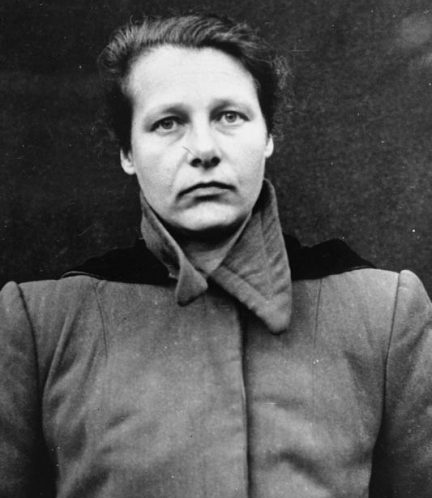
Born on May 15, 1911, in Cologne, Germany, Oberheuser pursued medical studies and earned her medical degree in the early 1930s, specializing in dermatology. By the time she completed her training, the Nazi Party had already risen to power. Oberheuser joined the Nazi Party in 1937 and later became affiliated with the SS, serving as a camp physician in Ravensbrück, a concentration camp primarily for women, from 1940 to 1943.
Her connection to the SS and the Nazi regime provided her with opportunities to advance her career, albeit through grotesque means. In her role as a camp doctor, she conducted experiments under the supervision of senior SS physicians like Karl Gebhardt, who was directly involved in the medical crimes at Ravensbrück.
Oberheuser became notorious for her direct participation in medical experiments on prisoners, particularly Polish political prisoners known as the “Ravensbrück rabbits.” These women were subjected to experiments that simulated battlefield injuries in an effort to study infection and develop treatments for German soldiers.
One of Oberheuser’s primary roles was conducting experiments that involved deliberately inflicting wounds on prisoners by cutting into their bones, muscles, and nerves. She introduced foreign objects like wood splinters, glass, and infected substances into these wounds to mimic combat injuries. These experiments often resulted in severe infections, gangrene, and unimaginable pain for the victims. Many of the women died, and survivors were left with permanent disabilities and disfigurement.
Oberheuser also worked on experiments related to sulfonamide, an antibiotic believed to combat infections in wounded soldiers. She intentionally infected prisoners with bacteria and treated them with the drug in various doses. The experiments were poorly designed, lacked scientific rigor, and caused immense suffering to the participants. In addition to these experiments, she performed unnecessary surgeries on prisoners and administered lethal injections of oil and evipan (a barbiturate) to those who were no longer deemed useful for experimentation. She reportedly kept some of the victims’ body parts as “samples,” underscoring her complete disregard for human dignity and life.
After the war, Oberheuser was arrested by Allied forces and charged with war crimes and crimes against humanity at the Nuremberg Doctors’ Trial (1946–1947). During the trial, evidence was presented detailing her direct involvement in the atrocities committed at Ravensbrück. Survivors provided harrowing testimony about the physical and psychological scars they endured under her care.
Oberheuser was convicted and sentenced to 20 years in prison. The court specifically cited her cruelty, her lack of medical ethics, and her active participation in the Nazi agenda as factors in her conviction. However, her sentence was later reduced to 10 years, and she was released in 1952 after serving only five years.
Upon her release, she attempted to resume her medical career. In 1956, she began working as a general practitioner in the German town of Stocksee. However, her past crimes eventually came to light when former Ravensbrück survivors recognized her. Due to public outcry and her history as a convicted war criminal, her medical license was revoked in 1958, effectively ending her career.
Oberheuser lived the remainder of her life in relative obscurity and died on January 24, 1978, at the age of 66.
Herta Oberheuser’s role in the Holocaust stands as a chilling reminder of how medical knowledge can be weaponized when ethics are abandoned. Her experiments not only inflicted unimaginable suffering but also failed to produce any meaningful scientific advancements. Oberheuser remains one of the most infamous figures in the history of Nazi medical crimes, and her actions contributed to the establishment of the Nuremberg Code, a set of ethical principles designed to ensure the protection of human subjects in medical research.
Her story serves as a grim warning about the consequences of unchecked power and the necessity of holding individuals accountable for crimes against humanity.
