


Hans Eppinger (January 5, 1879 – September 25, 1946) was an Austrian physician and Nazi collaborator infamous for his involvement in human experimentation during the Holocaust. Eppinger conducted unethical and deadly medical experiments on prisoners in Nazi concentration camps, particularly focusing on dehydration studies. His actions, deeply rooted in cruelty and pseudoscience, left a dark stain on medical history.
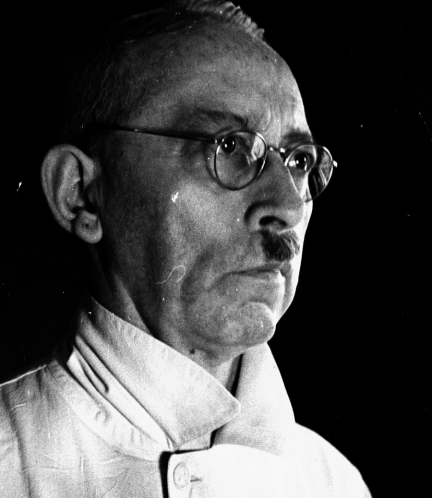
Eppinger’s medical reputation earned him recognition as a skilled clinician and researcher, and by the early 20th century, he had established himself as an expert in hepatology. However, his scientific career took a sinister turn when he aligned himself with the Nazi regime during World War II.
Eppinger joined the Nazi Party and became associated with the SS, which provided him with opportunities to further his research at the cost of human suffering. In the early 1940s, he was recruited to conduct experiments on prisoners in concentration camps, particularly at Dachau. These experiments aimed to address problems faced by the German military, often at the expense of the health and lives of those subjected to them.
Hans Eppinger is most infamous for his involvement in dehydration experiments conducted at the Dachau concentration camp in 1944. These experiments were designed to test methods of making seawater drinkable for German soldiers stranded at sea. The process involved removing salts from seawater, but the techniques being tested were scientifically unsound and caused severe physical harm to the subjects.
Prisoners were deprived of food and given only chemically altered seawater to drink, leading to extreme dehydration. Subjects experienced excruciating thirst, physical weakness, organ failure, hallucinations, and, in many cases, death. Survivors were left with lasting physical damage and psychological trauma. Eppinger’s experiments provided little to no scientific value and were conducted with utter disregard for human life.
After the fall of the Nazi regime, Eppinger was arrested by Allied forces and faced impending trial for war crimes. His name appeared prominently in investigations into the Nazi medical atrocities. However, before he could be prosecuted, Eppinger died by suicide on September 25, 1946, in Vienna. He reportedly ingested poison, avoiding accountability for his actions.
Hans Eppinger’s career is a stark example of how a respected medical professional can become complicit in atrocities when ethical principles are abandoned. Despite his contributions to hepatology earlier in life, his name is now irrevocably tied to the horrific human experimentation he conducted under the Nazi regime.
Eppinger’s actions helped spur the creation of the Nuremberg Code in 1947, a set of guidelines for ethical medical research that emphasizes informed consent, the necessity of scientific validity, and the obligation to avoid unnecessary suffering. His story serves as a warning about the potential for abuse of scientific authority and the vital importance of adhering to ethical principles in medicine and research.
